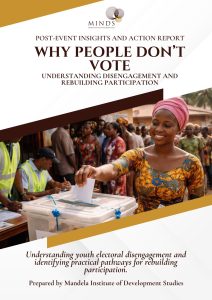
As Africa continues to navigate complex democratic and governance challenges, understanding why citizens choose not to participate in elections remains an important conversation. Through our Elections and Governance Program, we recently hosted a webinar titled “Why People Don’t Vote: Understanding Disengagement and Rebuilding Participation,” bringing together young leaders, governance practitioners, alumni, and civic engagement experts from across the continent.
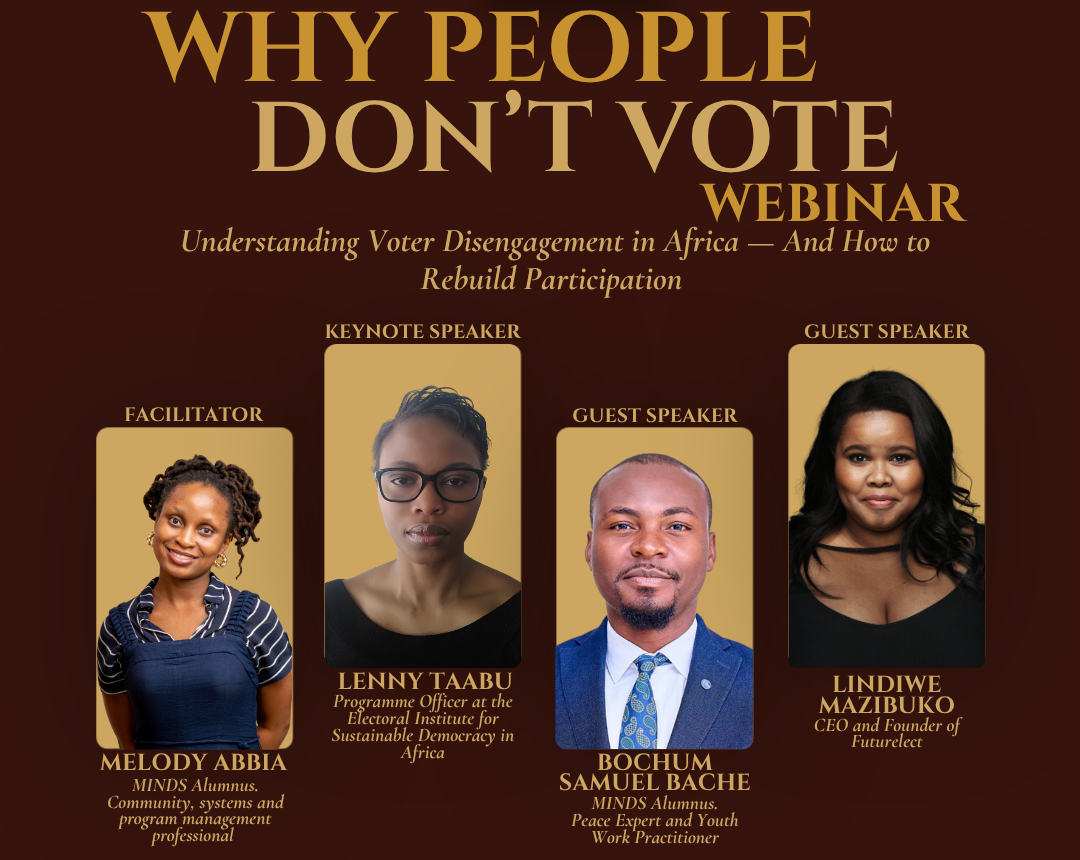
The webinar featured Dr Nkosana Moyo, CEO and Founder of MINDS Africa, Lenny Tabu from the Electoral Institute for Sustainable Democracy in Africa (EISA), MINDS Alumnus Bochum Samuel Bache, and Futurelect CEO Lindiwe Mazibuko. Together, they explored the factors contributing to declining voter participation and discussed how democratic engagement can be strengthened among young Africans. A central theme throughout the discussion was trust. Speakers noted that many young people are not disengaged because they do not care about politics or governance, but because they have lost confidence in the ability of elections and institutions to produce meaningful change. The conversation highlighted how perceptions of electoral integrity, accountability, and representation influence whether citizens believe their participation can make a difference.
The webinar challenged the common assumption that low voter turnout automatically reflects apathy. Instead, participants explored how many young people remain actively engaged in civic life through community initiatives, advocacy campaigns, social movements, and digital platforms. The discussion emphasised that civic participation extends beyond the ballot box and that these existing forms of engagement can serve as important pathways into formal democratic processes. Speakers also examined the structural barriers that prevent participation. These include electoral insecurity, administrative obstacles, corruption, economic pressures, limited access to political parties, and the high cost of seeking public office. The conversation highlighted that participation is often shaped not only by personal motivation but also by the broader political, social, and economic environment in which citizens operate.
Another important area of discussion focused on representation and inclusion. Participants stressed the need for young people to have meaningful opportunities to participate in leadership and decision-making processes. Particular attention was given to the challenges faced by young women, including safety concerns, social norms, unequal access to resources, and barriers to political participation.
The webinar concluded by shifting the conversation from diagnosis to action. Speakers encouraged young Africans to move beyond frustration and towards collective organisation, civic learning, and constructive engagement. Practical approaches such as citizen election observation, civic education, community mobilisation, and stronger accountability mechanisms were identified as important tools for strengthening democratic participation. The session reinforced MINDS Africa’s commitment to fostering informed dialogue, civic leadership, and democratic engagement across the continent. By creating spaces for young Africans to exchange ideas, share experiences, and explore practical solutions, the Elections and Governance Programme continues to contribute to building a more engaged, accountable, and participatory future for Africa.